ABM lite: how to start and run an account-based program on a limited budget
ABM lite: how to start and run an account-based program on a limited budget
For many people, when they think of account-based marketing (ABM), the first thing that comes to mind is the major platforms that have come to almost define ABM: Demandbase and 6Sense. What those platforms do is genuinely impressive, but these comprehensive ABM platforms also come with some drawbacks – they require resources and time to really get the most out of them, and they also require a monetary commitment. Contract costs for ABM platforms can range from a few thousand dollars a year up to over $100k a year for some.
But this shouldn't stop anyone interested in ABM from implementing ABM principles, and account- and persona-level targeting in marketing. It's not only possible – but more common than you might think – to utilize ABM approaches to ensure tailored messaging gets in front of the accounts most likely to have a need to buy from your company. This approach is generally known as "ABM-lite."
ABM is a principle, not a platform
Most prescriptions for ABM involve some kind of ABM-specific platform. But at its core ABM is a strategy, not a technology. Platforms make the strategy easier to run at scale, but are not necessary for implementing a strategic, account-based approach to commercial operations.
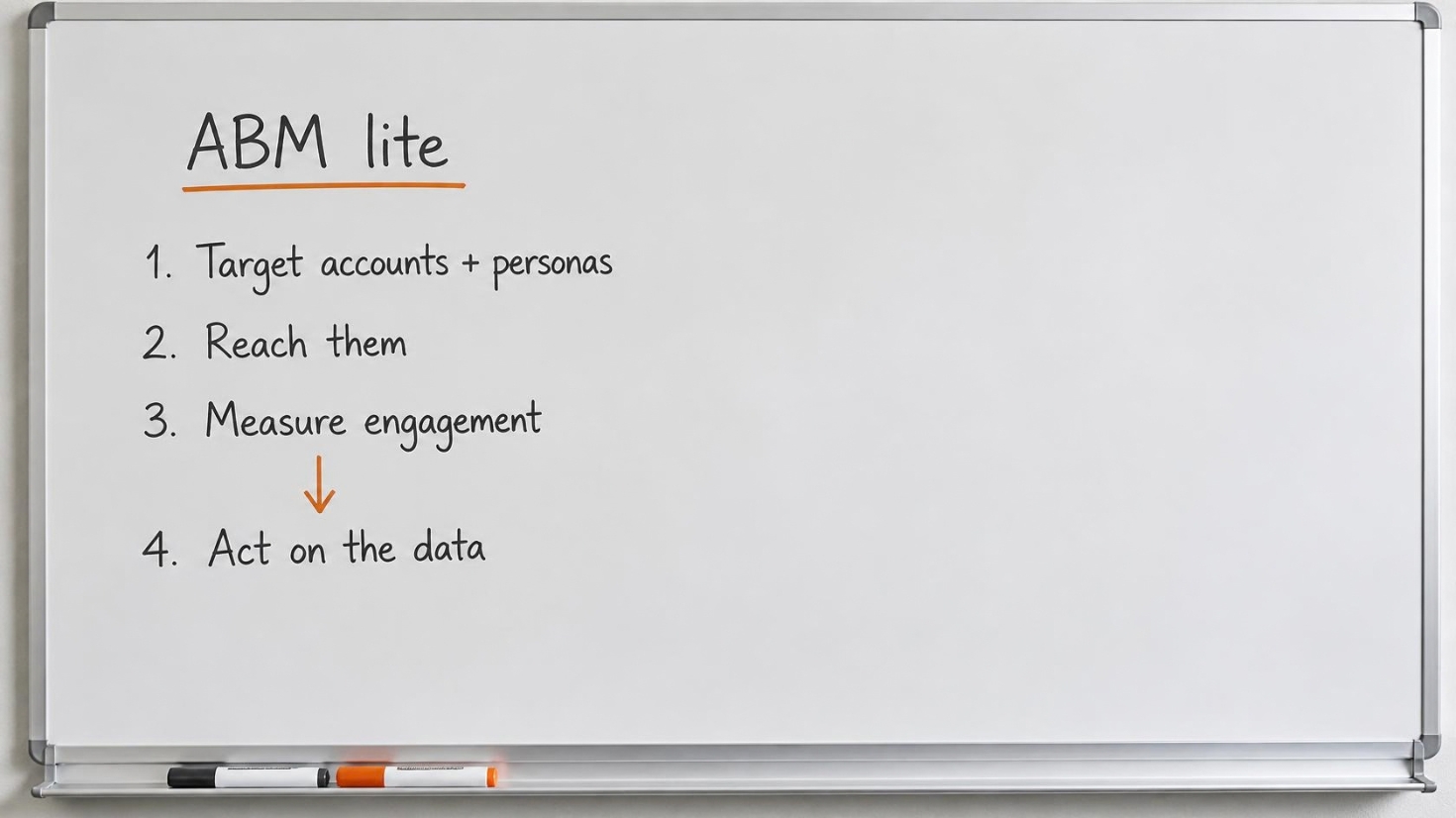
To incorporate an account-based approach into your marketing, only a few things are needed:
- A list of accounts and personas to target
- A way to specifically put your messaging and content in front of those accounts and personas
- The ability to measure account-level engagement
- A plan for what to do with that data
Each of these can be done without an ABM platform. The key thing ABM platforms do is merge engagement data from different sources at the account level to show which accounts are engaging, and deliver ads specifically targeted to your chosen accounts or contacts.
Building the account and persona list
The account list starts with a clear profile of the type of account you want to target, and a clear view of which of your solutions are aligned to those accounts. From there, the target list itself is built through market research.
In practice that means a documented ideal customer profile (ICP) first, ideally derived from your own revenue data rather than intuition; the post on building an ABM-aligned ICP covers that process in detail. Then use life-science-specific signals (clinical trial registrations, funding events, regulatory milestones, phase transitions) to find the accounts within that profile with a documentable, near-term reason to buy. That research can run through a life-science data platform, or through public sources pulled and merged by hand: ClinicalTrials.gov, SEC filings, company announcements, and grant databases for academic targets.
The persona list comes from your CRM data and from your sales and BD team, who know who is actually in the room when a deal of this type gets decided: the scientific end-user, the program lead, procurement. Write those titles down, along with the keywords that identify them, and review the resulting account list with the BD account owners before launch.
Getting in front of those accounts
With the list built, the next question is how to put messaging and content in front of those specific accounts and people. Two channels are the primary means of doing that in an ABM-lite program: LinkedIn advertising and email. Each has a clear strength and a clear limit.
LinkedIn advertising. The pro is precise targeting: company name, job title, function, and seniority can be layered together, so ads reach the defined personas at the defined accounts and very little else. The con is limited reach. If the people you're targeting aren't often on LinkedIn, the ability to reach them will be limited.
Email. The pro is that you know exactly who you're hitting and can see individual-level data. The con is that reach is limited by your CRM, or by what you might get from a database, and by spam rules. With a large opt-in database you can send a marketing email series, include links and content, and build aggregate data on which accounts and individuals are engaging.
Emails coming from BD or SDRs are generally specific about requesting meetings. ABM emails are often softer than that. You're offering something relevant and of value and tracking who engages, combining that with other engagement data, and trying to determine who you should elevate and recommend to your sales team for a more personalized outreach. The focus at this stage is to generate engagement and gather data; the meeting request comes later, from a person, with context.
Broadening reach with Microsoft Advertising. When LinkedIn's reach runs short, Microsoft Advertising can extend it while still using LinkedIn data. In certain regions, Microsoft's platform can target by LinkedIn profile attributes (company, industry, and job function) across its search and display inventory, so the same account and persona logic carries over to an audience that may not be active on LinkedIn itself. The targeting is less granular than LinkedIn's own, but it puts the campaign in front of the right companies in a second, broader environment.
Content syndication as an add-on. Placing gated content on third-party industry sites is a separate approach that can be layered on top of the two primary channels. It doesn't strictly align with ABM in that you can't focus your targeting only on certain accounts. But with gated content you get both account-level and individual-level engagement data, and you see the type of solution the person may be interested in. Form fills from accounts on your target list feed directly into the same engagement picture the primary channels are building.
Bringing the data together
Each channel above produces its own report: LinkedIn engagement by company and title, email opens and clicks by contact, syndication leads by name and company. And while useful on its own, this data becomes more powerful when merged into a combined analysis report that can show aggregate touchpoints across channels.
It's possible to do this analysis manually – or to create a complex Excel file with formulas for account-level scoring. However, this type of data analysis is where AI proves highly beneficial. You can provide the guidelines for what makes an account a sales qualified account (SQA), meaning one that's ready for sales to accept for outreach, kick over reports from each source, say, weekly, and let the AI analyze across the data sets to provide a report on aggregate account engagement, highlight individuals, and potential interests based on what was engaged with.
The guidelines don't need to be elaborate for a first campaign; often it's useful to set low thresholds in an initial campaign and tighten once more data becomes available about the typical profile of a ready-to-engage account. In Fractorial's client programs, the team typically starts at two or more engaged individuals per account as a component of the minimum threshold for an SQA.
Acting on the data
The weekly report is only useful if something happens next. Before launch, agree with sales on three things: what threshold moves an account to sales, who receives it, and what the outreach looks like. The handoff should ideally include account-level data on what content each account engaged with and what topics appear to be of interest. And if individual-level data is available (from email engagement or gated content engagement) then that should be included as well, so that whoever is doing sales outreach knows the best individual targets to reach out to.
Any accounts below the threshold stay in the campaign and keep accumulating touches. Accounts above it get personal attention.
Refresh the target list on a regular cadence as well. New trial registrations, programs, and funding rounds will keep surfacing accounts that fit the profile but weren't on the original list.
Where to start
None of this requires a platform license. It requires a defined ICP, a sales team willing to agree on what "qualified" means, content worth engaging with, and a weekly discipline of looking at the data together. That is ABM as a principle. The platform can come later, once the program has a track record of ROI that calls for expansion.
The design work up front is where a first program needs the most judgment: which segment to start with, which signals to use, what the persona map looks like, how to set the thresholds and the handoff. And this kind of deliberate, strategic approach to marketing will be beneficial even beyond any ABM campaigns you choose to run.
Recent articles
ABM lite: how to start and run an account-based program on a limited budget

Finding in-Market Sponsors: A BD Guide for CROs & CDMOs
A Prescription for Getting Started in Life Science ABM
Ready to Build a Smarter Marketing Engine?
Our work helps teams turn complex data into growth — driving qualified leads, higher engagement, and stronger campaign performance across every channel.