Life Science Marketing that Drives Real Business Results
From growth marketing to orchestrating full-funnel campaigns, Fractorial aligns strategy with your commercial vision and ensures your marketing delivers measurable results and drives consistent ROI.
who we serve
We help leaders and marketing teams build thought leadership, shorten sales cycles, and transform complex marketing data into clear intelligence that drives measurable success.

Scaling Startups
We help scaling startups build data-driven marketing foundations, focusing on high-ROI initiatives and data systems development to optimize spending and prepare for future growth.

Mid-Market Companies
For companies ready to implement robust and comprehensive marketing processes, we provide expertise to align tech stacks and create a unified marketing data ecosystem, and develop and deploy thought leadership and lead gen campaigns.

Enterprise Organizations
We help larger companies and enterprise organizations implement data-driven full-funnel and account-based marketing campaigns that align marketing, sales, and business development to transform marketing groups into revenue engines.
Trusted by organizations of all sizes to bring clarity and consistent ROI to their marketing
Our work delivers campaigns and results aligned to commercial goals, and builds a structure to ensure KPIs can be easily demonstrated.
Solutions
Solutions that make uncommon results commonplace
Our services optimize marketing through strategy, analytics, and campaign delivery, enabling life science companies to scale marketing efforts efficiently while maintaining the precision, continuous engagement, and audience trust essential to delivering consistent success.
Strategic Marketing Leadership & Consulting
Ensure your organization has the fundamentals - team, plan, technology, and data intelligence - aligned precisely to your business and built for high performance and scalable growth.
Marketing Data Intelligence
Move from disconnected data into a unified and actionable marketing analytics ecosystem that delivers trusted data to measure ROI, communicate results, and enable smarter decisions.
Thought Leadership & Lead Generation
Drive engagement, move leads down the funnel, and enable premium positioning for your products and solutions by developing the strategy and content that establishes you as experts across your entire target market.
Account-Based Marketing
Execute sophisticated, full-funnel marketing campaigns that generate demand and connect with target accounts and personas during every step of complex buying journeys.
Our process
Our process tailors every solution to your specific organizational needs and business goals
A true partnership, dedicated to achieving your goals, requires an agency to first understand your business and commercial structure. Through our detailed process, Fractorial ensures that the solutions we deliver are precisely tailored to help you grow.
Discovery & Strategy
Understanding your business and existing situation is a critical piece in working with you. We start by looking at key parts of your commercial structure to ensure that any solutions we deliver can support you now, and can scale with your business growth. We then identify strengths, key gaps, and designs solutions that will best help you meet and exceed your targets.
Audit of existing marketing processes, sales process, and available data
Identify gaps and key needs
ICP (ideal customer profile) development with audience segmentation and persona creation
Systems & Metrics Alignment
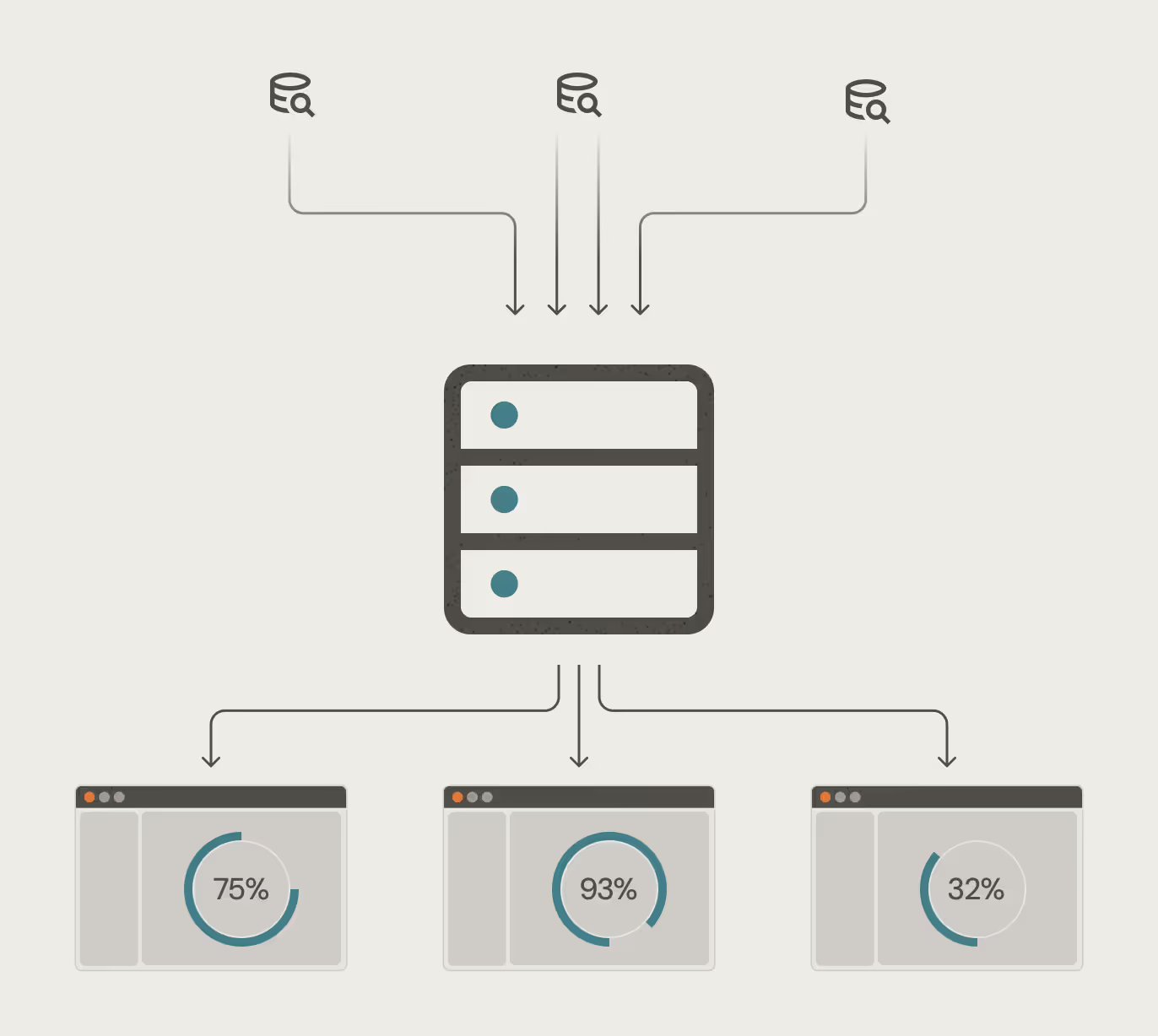
We then analyze your marketing systems, tech stack, and existing data sources to build a structure that can consistently measure and trend key data and results across all channels and campaigns. If ABM is an ideal approach, we can help you select and integrate a platform.
Marketing technology analysis
Data source mapping and harmonization
Comprehensive dashboard and report design
ABM platform selection, onboarding, and data alignment (if needed)

Content Planning & Development
Effective life science marketing requires content that speaks directly to the needs, challenges, and interests of each buying persona. We align with you to ensure you have the content needed to connect with all buyers and influencers at each stage of the marketing and buying funnel.
Mapping needed content and content types to personas
Building thought leadership strategy
Developing engagement, lead gen, and nurturing content
Execution & Optimization
Engagement, lead generation, and especially complex approaches like account based marketing require not only thoughtful content, but structured planning, audience selection, clearly defined goals and metrics, and a process to measure success and adjust as needed. We can execute campaigns for you, and build the structure for your team to repeatedly deploy and optimize even advanced campaigns.
Audience and tactic selection and timeline creation
For ABM: Development of structured campaign template and documentation
Creation of centralized campaign-specific dashboards and internal reporting template
Internal content development and sales/BD team training
Explore our latest insights on impactful life science marketing
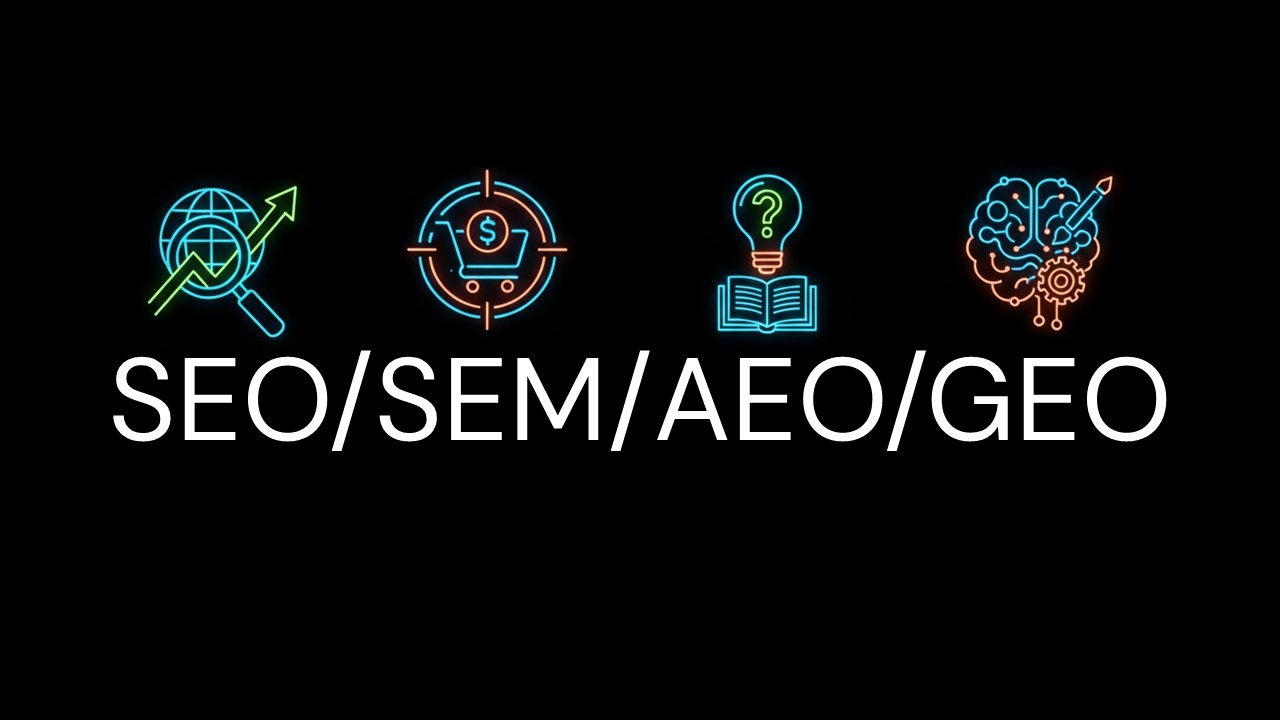
SEO vs. SEM vs. AEO vs. GEO: Navigating the New Architecture of Digital Discovery
In the current digital marketing landscape, the ground is shifting beneath our feet. For over two decades, the relationship between content creators and search engines was governed by what we call the "Traditional Bargain": marketers created high-quality, freely accessible content, and in exchange, search engines like Google directed relevant traffic to their websites. However, the rise of AI-driven discovery—specifically Answer Engines and Generative Engines—is fundamentally altering this agreement. For leadership in technical sectors like the life sciences, understanding both traditional search as well as AI-driven search is essential for deploying digital resources to ensure your authority remains visible.
A Short History of Search: From Curated Links to the Academic Model
To understand our current state, it’s helpful to know a bit about the history of search. Early web search was a digital Wild West. Starting with directory-style listings like AltaVista to early search engines like Yahoo, the process was often inefficient and ineffective. It was common for a user to click on a dozen or more links in order to find just one that was useful—if they ever found one at all. Furthermore, results could be manipulated through techniques like "keyword stuffing," which led to irrelevant results and a poor user experience.
Google revolutionized this landscape by adopting a logic borrowed from academia and scientific literature: ranking the relevance and importance of a page based on the number and quality of "citations" (links) pointing to it—much like how the significance of a peer-reviewed article is inferred. This revolutionary approach meant that results were based not just on what the engine saw on a page, but on what other real users and creators thought of that content.
This birthed the era of digital content marketing. Web creators realized that by developing high-quality, useful content, they could improve their site's authority and climb the rankings. Google actively encouraged this because their business model relied on providing the most relevant results to keep users coming back.
The Traditional Bargain was simple:
For Marketers: Invest time in creating great, free content, and Google will reward you with traffic that you can then convert into customers.
For Google: Encourage a web of great content to provide the best results for users, allowing Google to run highly relevant ads alongside those results to generate revenue.
But as AI usage becomes increasingly common, this bargain is changing. Users can now get answers in entirely new ways, which impacts how marketers must approach discovery.
Let’s explore the current (early 2026) status of search: from organic (unpaid) search, to paid search, to answer engines, and generative engines.
Search Engine Optimization (SEO): The Organic Foundation
Organic search is the foundation of search - unpaid results when a user searches for something. SEO is the art and science of getting your website to rank high in organic search results. It relies on a combination of high-quality content, technical site health, and established authority through backlinks.
Imagine you are in Denver, Colorado, and you are dealing with a blocked toilet. You go to Google and search for "plumber near me".
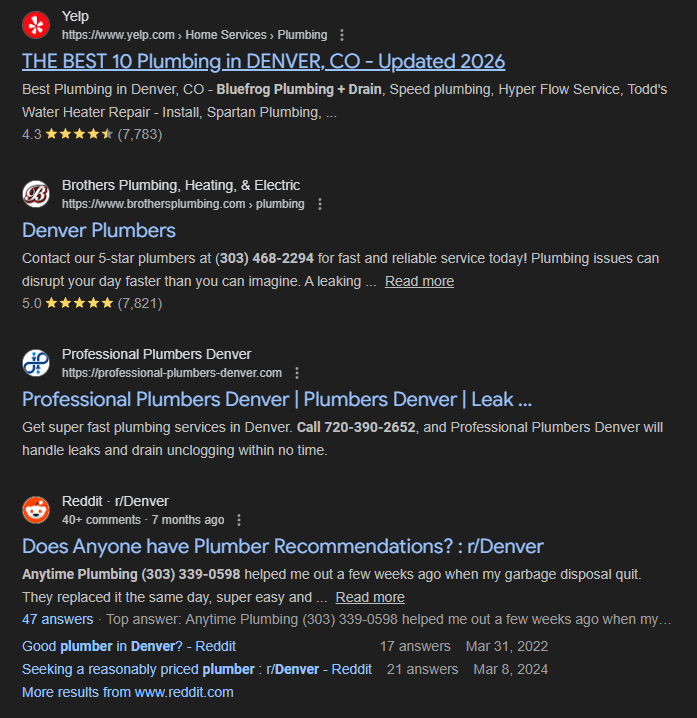
- The Result: Google may list businesses, and will also provide a list of organic links. Some might be actual plumbers, while others might be directory sites like Yelp. We can also see what is essentially a message board (Reddit) ranking, as Google thinks the discussion on the board may be useful.
- The Experience: While these results are relevant, you have to click on each link, evaluate the company’s service area, read through their pages, and find their contact information manually. It requires significant effort from the user to filter through the options to find an ideal match.
- The Strategy: SEO is still the bedrock of building a digital presence and building digital authority and (free) traffic. What you do to rank well in organic search can improve your ranking in paid search and in AI-powered search.
Search Engine Marketing (SEM): Targeted Paid Results
SEM is the paid side of search. Companies pay for their site to appear at the very top of the results page for specific, high-intent keywords, often through platforms like Google Ads.
Using the same "plumber near me" search in Denver:
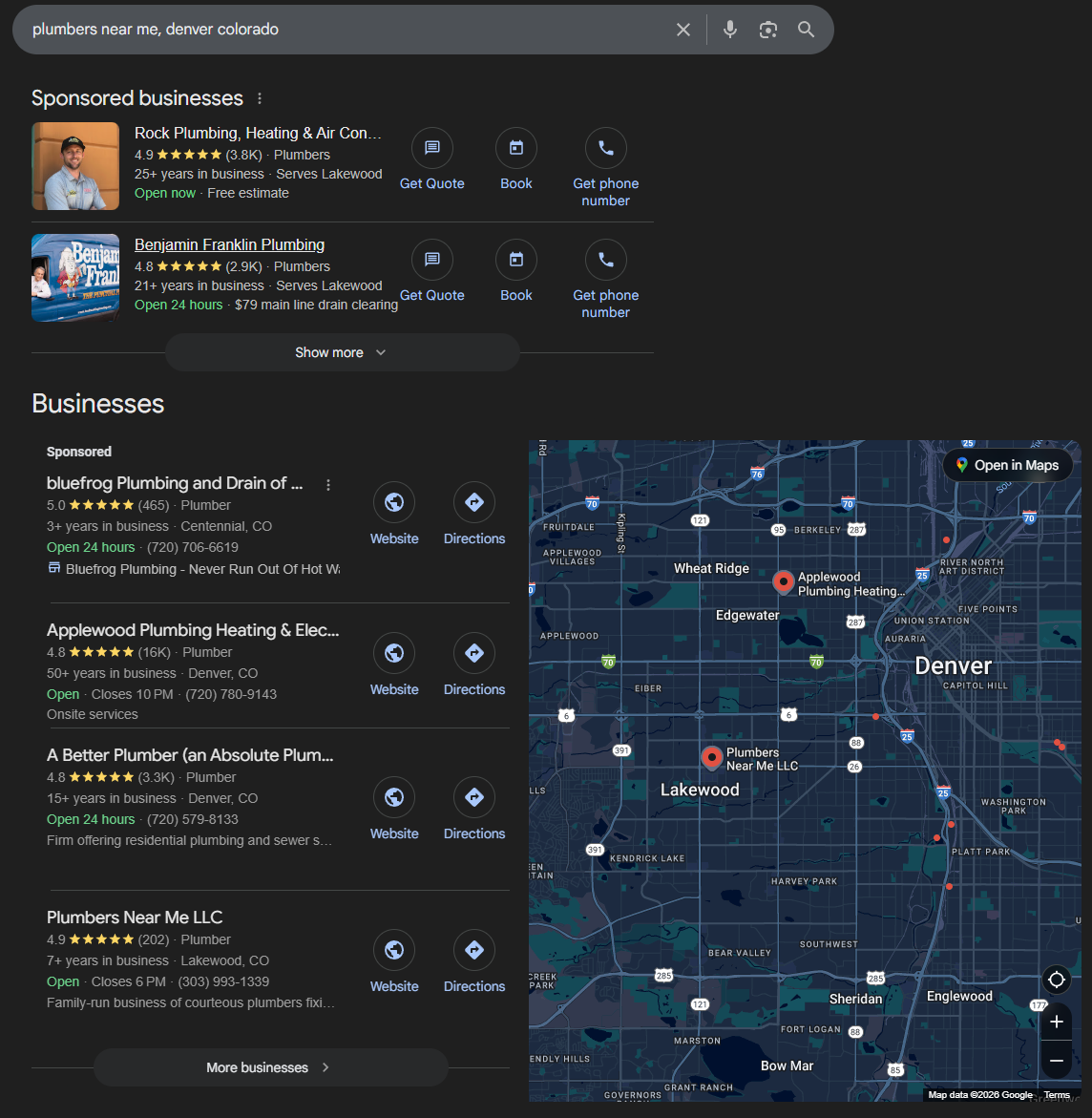
- The Result: At the very top, you see multiple "Sponsored" results.
- The Experience: These results may be more immediately useful than organic ones. They frequently include star ratings, direct "Call" buttons, and a link to book an appointment.
- The Strategy: Google makes an effort to make paid results useful because they generate revenue when these links are clicked. For the marketer, it provides instant visibility at the exact moment a customer has a need. However, without rigorous CRM integration and attribution tracking, SEM can become an inefficient spend. For life science organizations, SEM must be compliant and carefully managed to reach technical personas with precision.
Answer Engine Optimization (AEO): The Zero-Click Reality
AEO is a newer modality where the user no longer receives a list of links. Instead, they are provided with a direct result synthesized by a Large Language Model (LLM) or "Answer Engine". This is most commonly seen in Google's AI Overviews (AIO) or platforms like Perplexity. (Keep in mind terms like AEO and GEO are not fully settled, and the definitions may still change.)
Instead of a keyword search, the user might type a statement like: "I have a blocked toilet."

- The Result: Google’s AI Overview pulls content from multiple web sources to form a single, cohesive answer right on the search page.
- The Experience: The user might get all the immediate troubleshooting steps they need without ever clicking a link. While the sources are cited on the side, the traffic often stays within Google, and no click occurs (zero-click). This is where the Traditional Bargain breaks. The engine effectively repurposes your content but keeps the traffic for itself.
- The Nuance: While losing traffic is a risk, some argue that "no-click" users might have been low-quality targets anyway. High intent users may be looking for the content cited to find companies with authority, and may be more likely to then engage with your site and your company.
Generative Engine Optimization (GEO): Influencing AI Recommendations
GEO focuses on ensuring your company is presented and recommended by generative engines—such as ChatGPT, Gemini, or Claude—when a user asks for a recommendation or a complex comparison.
A user might ask Google’s Gemini: "What plumbers near me do you recommend?"
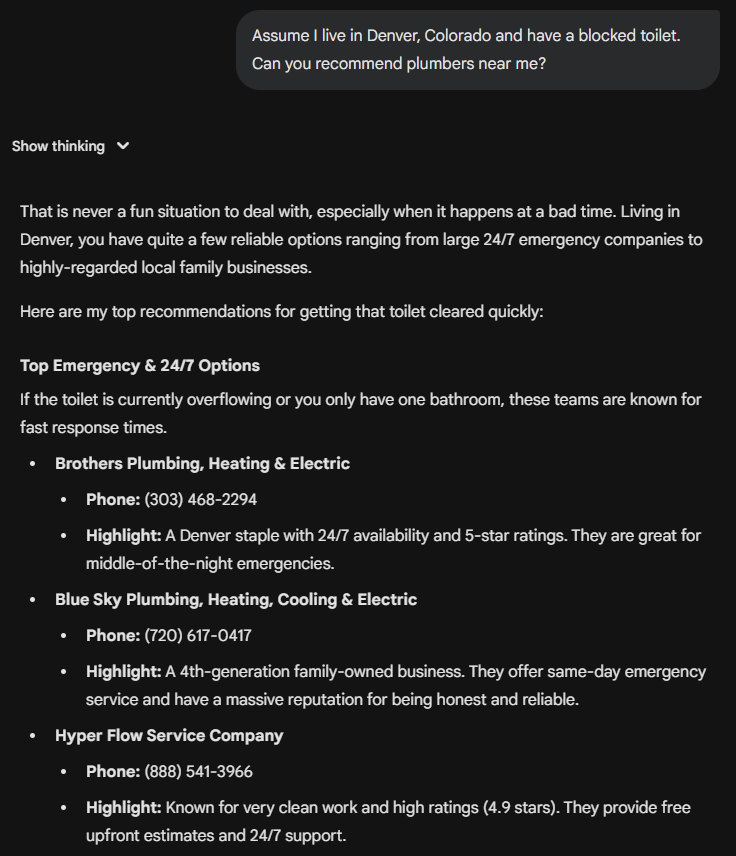
- The Result: The engine provides a synthesized response that might include a comparison of highly-rated local favorites, details on their specialties, and even advice on what to do before they arrive.
- The Experience: This is a personalized and useful response. A user is very likely to consider the plumbers specifically recommended by the AI before looking at a traditional list of links.
- The Strategic Value: Showing up in these generative responses is incredibly valuable because the AI acts as a trusted advisor, endorsing your business to the user. Consider a life science example: when a C-suite executive asks an AI, "Which CRO has the best track record for Phase II clinical trials in rare diseases?", GEO ensures your organization is the one recommended. It is about ensuring your "digital footprint" is authoritative enough for models to synthesize your value proposition accurately.
- The Strategic Reality: There is no "GEO strategy" separate from brand building. AI models are trained on the same content that builds your brand everywhere else. To win at GEO in life science marketing, you need mentions in authoritative publications, case studies that genuinely help people, and a strong reputation in your niche.
Should You Care About AEO and GEO?
The transition to AI-powered search raises a critical question: should you significantly change your strategy?
The Case for Caring About GEO: Users who ask generative engines for recommendations are often deep in the consideration phase. Being the recommended solution is a powerful competitive advantage. Building your brand will naturally build GEO and is something you should already be doing.
The Case for Caution With AEO: If AEO satisfies the user's curiosity immediately, your click-through rates may drop. Putting effort into ranking highly for answer engines (especially at the expense of improving SEO) may not be the best strategy for your business. You do have the chance to develop authority by being shown, and some users may click through, but many may not. (However, many of these "no-click" users may not have really been good targets.)
How to Optimize for the Future
Transitioning to this new era requires moving from "managing a website" to "managing a technical narrative" parsed by both humans and machines. Regardless of whether you focus strongly on AEO and GEO, there are ways to position your company well.
- Structure for Machines: Use schema markup and structured data to help answer engines and LLMs easily parse and cite your expertise.
- Build High-Value Content: Focus on "high-value" assets like proprietary research, technical white papers, webinars, and case studies. These are the signals that generative engines use to verify your authority. Additionally, AI models are trained on the web's collective knowledge. The more your brand is mentioned in authoritative contexts, the more likely you are to be a GEO recommendation.
- Audit Your Data: Ensure you have a unified data ecosystem. You need to see if those "zero-click" AI interactions are actually leading to downstream revenue. This will help you determine whether you should alter your focus for the future.
Aside from focusing on search, continue to develop engagement and authority through other means. Use a mix of email, social, and direct engagement to own your audience so that you aren't entirely dependent on the changing "search bargain".
Conclusion: Strategies for the New Era
Despite these shifts, the core of successful B2B marketing remains the same: building authority. Especially in the life sciences, where buyers are inherently skeptical and sales cycles are long, your technical authority is your most valuable asset. By building scientifically fluent content and a robust data foundation, you ensure that no matter how search changes, your business remains the primary signal in an increasingly noisy, AI-driven world.
References & Further Reading
If you're looking to dive deeper into the technical nuances and industry debates surrounding these emerging search technologies, here are some additional resources:
- WTF are GEO and AEO? (and how they differ from SEO) – Digiday
- Why We Should Stop Saying Generative Engine Optimization — Answer Engine Optimization Makes More Sense – Forbes
- Déjà Vu All Over Again? Answer Engine Optimization Is a Familiar Trap – Content Marketing Institute
- AEO vs. GEO: Why they're the same thing (and why we prefer AEO) – Profound

How to Gain Lead Flow Insights with a Sankey Diagram
The Importance of Data Visualization in Marketing
In modern marketing we generate significant amounts of commercial data, yet especially in life sciences marketing we often suffer from insight scarcity. The role of a marketing leader is not just to generate leads, but align with the commercial organization, understand how marketing is working, and engineer a consistent revenue engine. To do this, effectively visualizing your data in order to create actionable insights is critical.
Just as a scientist visualizes experimental results to make hypotheses and plan next steps, a marketing leader must visualize the "Commercial Physiology" of their organization. Effective visualization can help diagnose friction points, calibrate budget allocation, and validate the return on investment for complex, multi-channel strategies.
Standard vs. Complex Charts and Diagrams
Most marketing dashboards rely on a standard set of static visuals: bar charts for volume, line graphs for trends, and basic funnel diagrams for conversion rates and movement from one stage of engagement to the next. While these are useful for isolating specific metrics (e.g., "How many MQLs did we generate last month?"), they fail to capture the fluidity and interconnectivity of a more complex marketing organization - especially where multiple touchpoints or sales team layers exist. A linear funnel assumes a single path to purchase, but the reality of life science procurement is non-linear and complex. To map this reality and provide deeper insights into commercial lead and opportunity flow, a Sankey diagram can be highly useful.
What is a Sankey Diagram and Why is it Useful for Marketers?

A Sankey diagram is a specific type of flow diagram where the width of the arrows is proportional to the flow quantity. For marketers, it's a highly useful tool for visualizing how leads move through your entire commercial system.
Unlike a basic funnel, a Sankey diagram provides a high-fidelity view of:
- Volume Source: Exactly how many leads are coming from each specific channel (e.g., Webinars vs. paid search vs. ABM) and where those leads enter the funnel.
- Systemic Movement: How those leads traverse—or fail to traverse—the commercial stages.
- Data Hygiene Gaps: Perhaps most importantly, the process of constructing a Sankey diagram acts as a stress test for your data. If you try, but can't construct a Sankey that connects a lead source all the way to a closed-won deal, you've now identified gaps in your tracking infrastructure and you will struggle to report on ROI from your marketing efforts.
How to Create a Marketing Sankey
Creating a Sankey diagram is as much a process of "Data Harmonization" as it is design.
- Step 1 - Select Your Tool: Identify the tools you will use. There are many dedicated Sankey web sites likes sankeyart.com or SankeyMATIC.com, and there are even Excel plugins to allow you to create a Sankey directly from your Excel data. We prefer SankeyMATIC for its combination of ease of use, flexibility, and price (free!)
- Step 2 - Data Gathering: You must list out every lead source and define your funnel stages (i.e. MQL, SQL, SAL, Opportunity, etc.) Consistency in naming conventions is critical here to ensure the data flows logically.
- Step 3 - Define How Leads Flow: Not all leads behave the same. Some leads flow from one stage to the next, some leads may move directly to BD. Some leads may enter the funnel as MQLs; some may enter and immediately be triaged as SQLs. You must map the logic: do "hot" leads go directly to Sales? Do "warm" leads go to Nurture? This triage logic must be explicitly defined in your data set.
- Step 4 - "Dummy Data" As Needed: If your current CRM data is messy, or if you can’t perfectly map out all of these steps, keep going! It is a highly valuable exercise to create "dummy data" to map out what your ideal process should look like. This allows you to visualize the "Theoretical Funnel" and identify exactly where your real-world data is failing to match the model, and can help you figure out how to build in systems to allow you to better fully track your leads and funnel.
Case Study: Creating a Sankey for a Multi-Channel Life Science Engine
For an example of how to create a Sankey, let’s look at a hypothetical case study of a mid-sized life science organization:
Commercial Structure
The organization consists of three distinct commercial units: a Marketing Team generating inbound interest and nurturing leads, a Sales Development (SDR) team performing outreach to generate warm leads, and also turning marketing leads into meetings, and a Business Development (BD) team closing deals while also sourcing some of their own deals.
Data Inputs
We will utilize the following data set to construct our "Commercial Flow." Note how we track multiple distinct channels for lead generation:
Top of Funnel (MQL Sources):
- Conferences (2000)
- Webinars (1000)
- Account-Based Marketing (2500)
- Gated Content (400)
Mid-Funnel (Qualification):
- The SDR team sources 1000 leads directly.
- MQLs are triaged: 1000 move to SQL status, while the remainder are automatically routed to a Nurture phase.
Bottom Funnel (Conversion):
- SQLs convert to Meetings/SAL (Sales Accepted Leads). Those that do not convert return to Nurture.
- We also track "Direct-to-Meeting" sources, including high-intent SEO traffic (200), Paid Search (100), and leads sourced directly by the BD team (50).
Revenue Realization: We track the flow from Meetings (200) to Opportunities and finally to 75 Won Business deals.
Input Code
Based on the data inputs above, we can create a code block showing lead sources and destinations in the format of 'Source [number of leads] Destination Stage'. Here is the code based on the data inputs above:
// Top of Funnel Inputs
Conferences [2000] MQL
Webinars [1000] MQL
ABM [2500] MQL
Gated Content [400] MQL

// Mid-Funnel Triage
SDR Team [1000] SQL
MQL [1000] SQL
MQL [*] Nurture  // Remainder of MQLs move to Nurture
Nurture [150] Meetings/SAL // Nurture re-engagement

// Sales Handoff
SQL [150] Meetings/SAL
SQL [*] Nurture // Unconverted SQLs return to Nurture
SEO [200] Meetings/SAL
Paid Search [100] Meetings/SAL
BD Team [50] Meetings/SAL

// Revenue
Meetings/SAL [200] Opportunity
Opportunity [75] Won Business
Output
Here is the output Sankey diagram, created in SankeyMATIC.com:
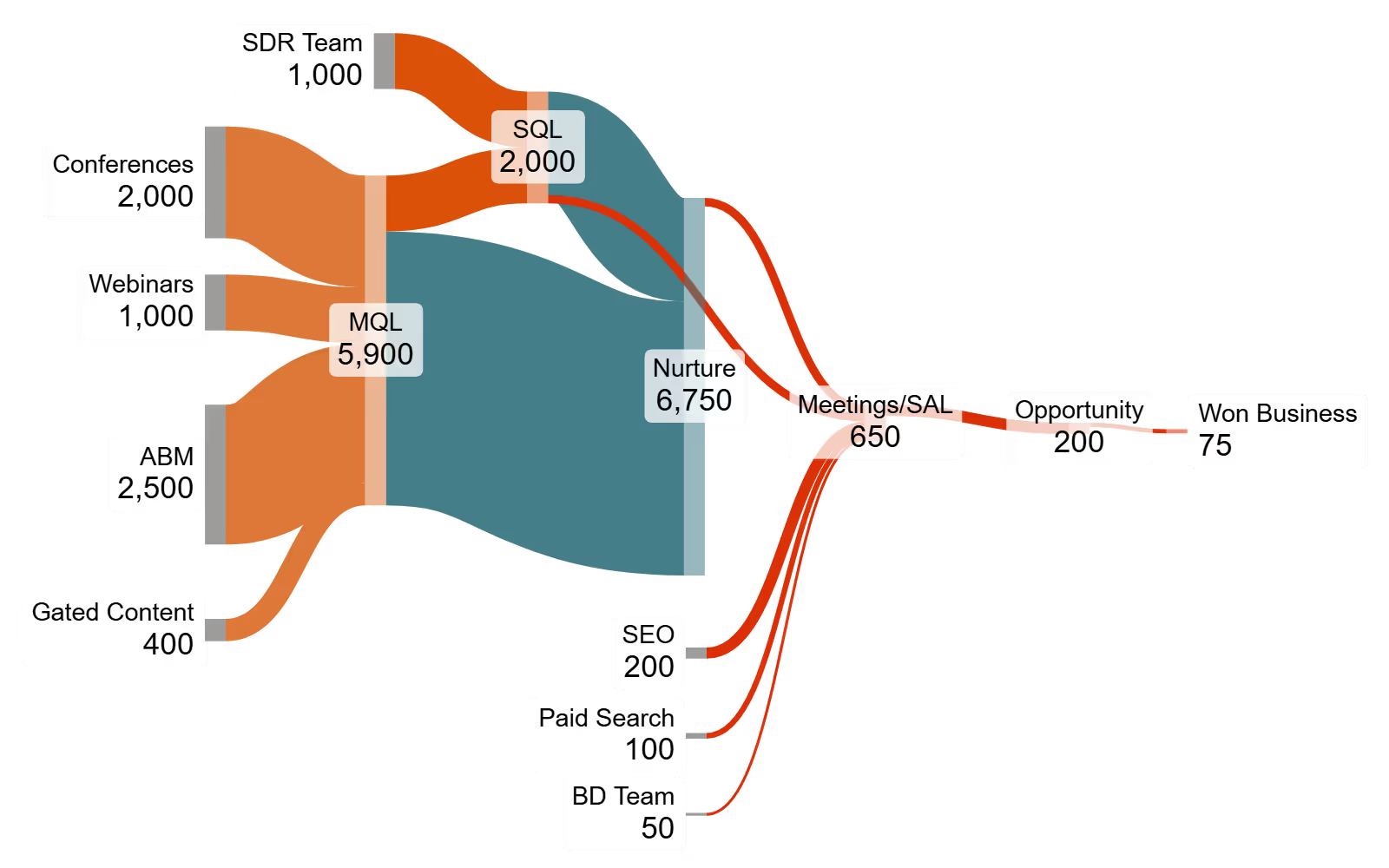
Interpreting the Sankey Diagram
Now that we have created our Sankey using the code above, we can analyze and see what it shows us. By visualizing our lead flows and stages, we can immediately see the importance of the nurture stage, and of continuous nurturing to drive meetings. We can observe that while ABM drives the highest volume of MQLs, a significant portion require nurturing before becoming sales-ready. Conversely, we can validate that SDR-sourced leads have a more direct path to SQL status, and see that search contributes to nearly half of the SALs generated.
Additionally, after the Sankey is created we can adjust the diagram including colors, the location of the nodes, and the flow direction to customize the visualization. For example, we could adjust colors and layout to highlight specific "At-Risk" pathways or "High-Velocity" channels, giving you a report-ready visual of your commercial health.
Using Data Effectively to Guide Your Strategy and Tactics
Data for its own sake has limited usefulness - but if structured and visualized well, it can be an invaluable tool to help guide your work. We’d encourage all marketers to experiment with different ways of visualizing data. Doing so will help you understand your data better, identify data gaps, will provide insight into what your marketing is doing, and make you more conversant in explaining the results.
At Fractorial we can design and run complex, data-driven campaigns for you, and also build the platforms and approaches to enhance your ability to be a data-driven marketing organization. Contact us if you're interested in learning more.

Empower Your Sales Team with Data, Increase Their Win Rate
In the highly technical and competitive landscape of the life science industry—whether selling capital equipment, reagents, or CRO services—the difference between a closed deal and a stalled opportunity may lie in information visibility. While scientific expertise and relationship-building remain critical, the modern life science sales environment demands a rigorous, data-driven approach.
A question frequently asked by commercial leaders in the life sciences is: How can we empower our sales teams with tangible data that directly contributes to increased win rates? This article explores the critical role that marketing-generated data can have in helping business development teams navigate complex scientific sales cycles and outlines strategies for leveraging account engagement insights to close active deals.
The Dynamics of Life Science Sales Cycles
Sales cycles for capital research equipment, software systems, or scientific services are notoriously protracted. They often extend over months or beyond a year, involving a complex "Buying Committee" that can include Principal Investigators (PIs), Lab Managers, Procurement Officers - and depending on the product or service, the C-suite or specific groups like IT or even Environmental Health and Safety (EHS) personnel may become involved.
During these lengthy engagements, several factors complicate the process. Take for example some of the challenges in an example capital research equipment sale:
- The "Hidden" Evaluation: Scientists may conduct extensive technical due diligence online—comparing specifications, reading application notes, and reviewing peer-reviewed citations—long before, or even during, their engagement with a sales representative.
- Divergent Stakeholder Priorities: A PI may prioritize sensitivity and resolution, while a Lab Manager focuses on workflow integration, and Procurement focuses on the Total Cost of Ownership (TCO).
- Information Asymmetry: The sales may be doing their best to respond to the explicit requests from the customer, but not all of the concerns or considerations may be reaching sales. They may lack visibility into which specific technical concerns are currently driving the buying committee’s internal discussions.
Without data visibility, navigating these cycles is inefficient if the salesperson can’t address the specific concerns of the buying committee members. Sales teams need real-time insights not just to bring in new leads, but to understand the nuances of active opportunities.
The Misconception: Marketing Data vs. Sales Intelligence
There is significant confusion about the utility of marketing data for sales. Sales professionals in the life sciences are often focused on direct technical consultation. Consequently, they may view marketing metrics—such as web site engagement, email content clicks, webinar attendance or whitepaper downloads—as nice to know, but not wholly relevant to their open deals. And marketing teams may consider their responsibility “done” once a qualified lead is handed to sales, thinking at that point winning the business sits wholly with the sales team.
This is a critical oversight. In the life sciences, content consumption may be a direct proxy for technical intent. And the most effective marketing teams continue to support sales along the entire buying cycle. But challenges exist:
- Signal-to-Noise Ratio: Marketing teams generate vast amounts of data. Sales reps should not be expected to search and filter among this data to find what is relevant.
- Enabling Connections: The goal is to convert "marketing data" into "sales intelligence." For example: when a prospect interacts with specific scientific content, they are signaling a specific technical need or objection. Sales must know about this and know how to react effectively but the often don't have these insights.
The Critical Role of Data in Open Opportunities
While data is a key part of lead generation and nurturing, an equally important value of account-level data in the life sciences applies to managing existing open opportunities. Once a deal is in the pipeline, the sales representative’s primary challenge is maintaining momentum and alignment with the buying committee.
Access to granular account engagement data changes the dynamic in several specific ways:
1. Deciphering Consideration Factors
If an opportunity has stalled, data can reveal why.
- Example: If stakeholders at a target account suddenly begin viewing pages related to "software integration" or "automation compatibility," the sales rep knows that workflow integration is a key consideration factor.
- Action: The rep can preemptively provide case studies regarding LIMS integration, addressing the unvoiced concern before it becomes an objection.
2. Mapping the Buying Committee
In complex equipment sales, the decision-maker is rarely a single individual. Data allows the sales team to see who is engaging.
- The User vs. The Buyer: If the PI stops engaging, but a Procurement Officer downloads a "Service and Warranty Guide," the deal has likely moved from technical evaluation to commercial negotiation.
- Tailored Messaging: Knowing who is active allows for surgical precision in communication. The rep can send technical performance data to the scientist and ROI/longevity data to the operational manager.
3. Providing a Natural Reason for Sales to Re-engage with a Buyer
In long sales cycles, there may be times where a sales rep is naturally waiting on the buyer. Perhaps the target account has told the rep to wait, or the project has been delayed. If someone from the target account is seen to have registered for a webinar, or downloaded content, this can provide the sales team a low pressure way to follow up and re-engage with the buyer - while addressing something that is likely relevant to the buyer.
Case Study: Closing the Deal on a Flow Cytometer
Consider a manufacturer of high-end flow cytometry equipment. The typical sales cycle is 6–12 months and the price point exceeds $200k.
- The Scenario: A sales representative has an open opportunity with a large pharmaceutical research lab. The demo was successful, but communication has gone silent for three weeks. The rep is unsure if the lab is looking at competitors or simply waiting on budget approval.
- The Data Insight: Through an integrated dashboard, the rep receives a notification: Two individuals from the client’s IT and Data Security team have just visited the product’s "Data Compliance and Cloud Security" page.
- The Analysis: The rep realizes the delay isn't scientific—it's infrastructural. The buying committee has expanded to include IT, who are vetting the software's compliance.
- The Resolution: Instead of sending a generic "Just checking in" email, the rep immediately forwards a comprehensive "IT Security & Compliance Package" to the Lab Director to share with their IT team. The roadblock is removed, and the deal proceeds to the final stage.
In Practice: Creating a Sales Dashboard
To operationalize this, organizations must implement a dashboard that translates digital signals into actionable sales information.
Key Components for Scientific Sales:
- Identify Key Accounts: Ensure alignment with the Sales or Business Development (BD) team to identify not only target accounts but high priority ones - their "Top 20" scientific accounts (e.g., specific biotech hubs or academic institutions).
- Map Content to Buying Stages: Tag marketing assets by their role in the funnel (e.g., "Application Note" = Technical Interest; "Site Prep Guide" = Late Stage/Logistics).
- Build a Self-Service Dashboard: create a dashboard for each sales person with this key intelligence aligned to their specific accounts, that they can visit themselves, but also build in automated summaries and key alerts.
- Opportunity-Centric Alerts: Configure the system to trigger alerts specifically when activity occurs on an account with an open opportunity.
- Weekly Intelligence Summary: Send a weekly digest to BD summarizing which accounts were active and what content they engaged in.
Conclusion
In the life science industry, where products are complex and stakes are high, data acts as the radar for the sales team. By leveraging account engagement data, sales leaders can do more than just identify leads; they can uncover the hidden variables in active deals, identify the changing cast of characters in the buying committee, and tailor their scientific consulting to the exact needs of the moment. Empowering the team with this data transitions them from reactive vendors to proactive partners, directly increasing their win rate, and allows marketing to be seen as a true partner to the sales and BD teams.
Frequently Asked Questions
Common questions on working with us and on how to have a successful engagement.
Ready to Build a Smarter Marketing Engine?
Our work helps teams turn complex data into growth — driving qualified leads, higher engagement, and stronger campaign performance across every channel.