SEO vs. SEM vs. AEO vs. GEO: Navigating the New Architecture of Digital Discovery
In the current digital marketing landscape, the ground is shifting beneath our feet. For over two decades, the relationship between content creators and search engines was governed by what we call the "Traditional Bargain": marketers created high-quality, freely accessible content, and in exchange, search engines like Google directed relevant traffic to their websites. However, the rise of AI-driven discovery—specifically Answer Engines and Generative Engines—is fundamentally altering this agreement. For leadership in technical sectors like the life sciences, understanding both traditional search as well as AI-driven search is essential for deploying digital resources to ensure your authority remains visible.
A Short History of Search: From Curated Links to the Academic Model
To understand our current state, it’s helpful to know a bit about the history of search. Early web search was a digital Wild West. Starting with directory-style listings like AltaVista to early search engines like Yahoo, the process was often inefficient and ineffective. It was common for a user to click on a dozen or more links in order to find just one that was useful—if they ever found one at all. Furthermore, results could be manipulated through techniques like "keyword stuffing," which led to irrelevant results and a poor user experience.
Google revolutionized this landscape by adopting a logic borrowed from academia and scientific literature: ranking the relevance and importance of a page based on the number and quality of "citations" (links) pointing to it—much like how the significance of a peer-reviewed article is inferred. This revolutionary approach meant that results were based not just on what the engine saw on a page, but on what other real users and creators thought of that content.
This birthed the era of digital content marketing. Web creators realized that by developing high-quality, useful content, they could improve their site's authority and climb the rankings. Google actively encouraged this because their business model relied on providing the most relevant results to keep users coming back.
The Traditional Bargain was simple:
For Marketers: Invest time in creating great, free content, and Google will reward you with traffic that you can then convert into customers.
For Google: Encourage a web of great content to provide the best results for users, allowing Google to run highly relevant ads alongside those results to generate revenue.
But as AI usage becomes increasingly common, this bargain is changing. Users can now get answers in entirely new ways, which impacts how marketers must approach discovery.
Let’s explore the current (early 2026) status of search: from organic (unpaid) search, to paid search, to answer engines, and generative engines.
Search Engine Optimization (SEO): The Organic Foundation
Organic search is the foundation of search - unpaid results when a user searches for something. SEO is the art and science of getting your website to rank high in organic search results. It relies on a combination of high-quality content, technical site health, and established authority through backlinks.
Imagine you are in Denver, Colorado, and you are dealing with a blocked toilet. You go to Google and search for "plumber near me".
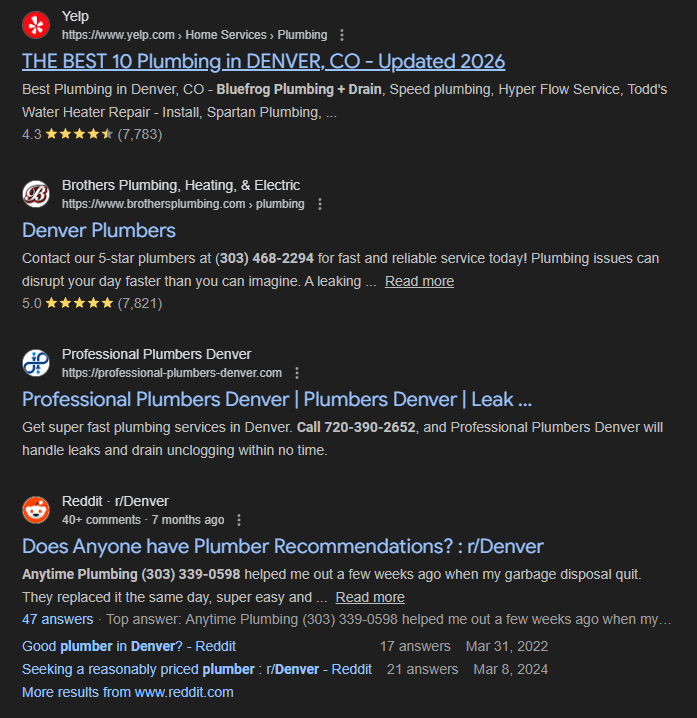
- The Result: Google may list businesses, and will also provide a list of organic links. Some might be actual plumbers, while others might be directory sites like Yelp. We can also see what is essentially a message board (Reddit) ranking, as Google thinks the discussion on the board may be useful.
- The Experience: While these results are relevant, you have to click on each link, evaluate the company’s service area, read through their pages, and find their contact information manually. It requires significant effort from the user to filter through the options to find an ideal match.
- The Strategy: SEO is still the bedrock of building a digital presence and building digital authority and (free) traffic. What you do to rank well in organic search can improve your ranking in paid search and in AI-powered search.
Search Engine Marketing (SEM): Targeted Paid Results
SEM is the paid side of search. Companies pay for their site to appear at the very top of the results page for specific, high-intent keywords, often through platforms like Google Ads.
Using the same "plumber near me" search in Denver:
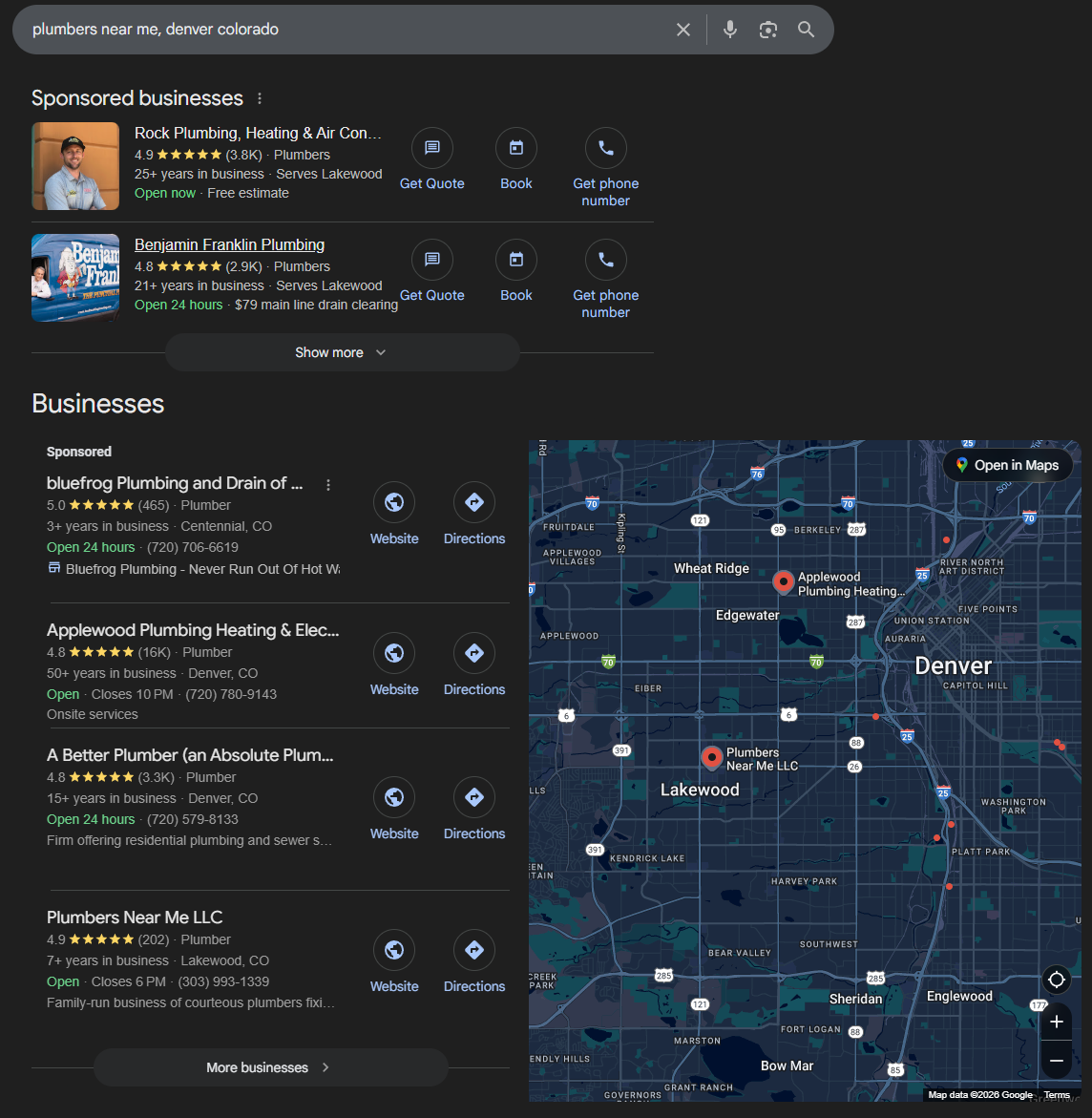
- The Result: At the very top, you see multiple "Sponsored" results.
- The Experience: These results may be more immediately useful than organic ones. They frequently include star ratings, direct "Call" buttons, and a link to book an appointment.
- The Strategy: Google makes an effort to make paid results useful because they generate revenue when these links are clicked. For the marketer, it provides instant visibility at the exact moment a customer has a need. However, without rigorous CRM integration and attribution tracking, SEM can become an inefficient spend. For life science organizations, SEM must be compliant and carefully managed to reach technical personas with precision.
Answer Engine Optimization (AEO): The Zero-Click Reality
AEO is a newer modality where the user no longer receives a list of links. Instead, they are provided with a direct result synthesized by a Large Language Model (LLM) or "Answer Engine". This is most commonly seen in Google's AI Overviews (AIO) or platforms like Perplexity. (Keep in mind terms like AEO and GEO are not fully settled, and the definitions may still change.)
Instead of a keyword search, the user might type a statement like: "I have a blocked toilet."

- The Result: Google’s AI Overview pulls content from multiple web sources to form a single, cohesive answer right on the search page.
- The Experience: The user might get all the immediate troubleshooting steps they need without ever clicking a link. While the sources are cited on the side, the traffic often stays within Google, and no click occurs (zero-click). This is where the Traditional Bargain breaks. The engine effectively repurposes your content but keeps the traffic for itself.
- The Nuance: While losing traffic is a risk, some argue that "no-click" users might have been low-quality targets anyway. High intent users may be looking for the content cited to find companies with authority, and may be more likely to then engage with your site and your company.
Generative Engine Optimization (GEO): Influencing AI Recommendations
GEO focuses on ensuring your company is presented and recommended by generative engines—such as ChatGPT, Gemini, or Claude—when a user asks for a recommendation or a complex comparison.
A user might ask Google’s Gemini: "What plumbers near me do you recommend?"
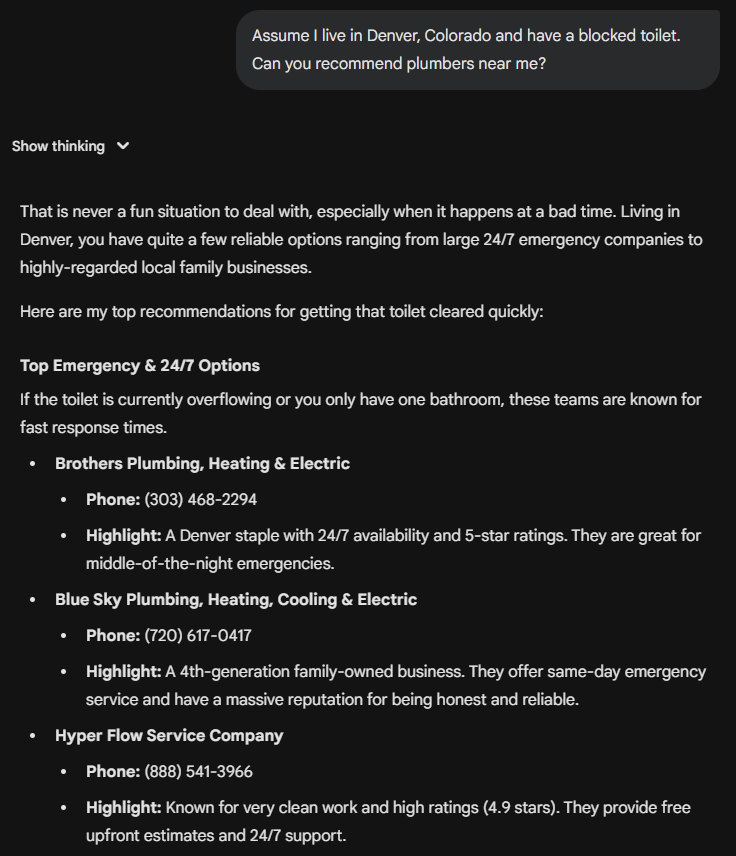
- The Result: The engine provides a synthesized response that might include a comparison of highly-rated local favorites, details on their specialties, and even advice on what to do before they arrive.
- The Experience: This is a personalized and useful response. A user is very likely to consider the plumbers specifically recommended by the AI before looking at a traditional list of links.
- The Strategic Value: Showing up in these generative responses is incredibly valuable because the AI acts as a trusted advisor, endorsing your business to the user. Consider a life science example: when a C-suite executive asks an AI, "Which CRO has the best track record for Phase II clinical trials in rare diseases?", GEO ensures your organization is the one recommended. It is about ensuring your "digital footprint" is authoritative enough for models to synthesize your value proposition accurately.
- The Strategic Reality: There is no "GEO strategy" separate from brand building. AI models are trained on the same content that builds your brand everywhere else. To win at GEO in life science marketing, you need mentions in authoritative publications, case studies that genuinely help people, and a strong reputation in your niche.
Should You Care About AEO and GEO?
The transition to AI-powered search raises a critical question: should you significantly change your strategy?
The Case for Caring About GEO: Users who ask generative engines for recommendations are often deep in the consideration phase. Being the recommended solution is a powerful competitive advantage. Building your brand will naturally build GEO and is something you should already be doing.
The Case for Caution With AEO: If AEO satisfies the user's curiosity immediately, your click-through rates may drop. Putting effort into ranking highly for answer engines (especially at the expense of improving SEO) may not be the best strategy for your business. You do have the chance to develop authority by being shown, and some users may click through, but many may not. (However, many of these "no-click" users may not have really been good targets.)
How to Optimize for the Future
Transitioning to this new era requires moving from "managing a website" to "managing a technical narrative" parsed by both humans and machines. Regardless of whether you focus strongly on AEO and GEO, there are ways to position your company well.
- Structure for Machines: Use schema markup and structured data to help answer engines and LLMs easily parse and cite your expertise.
- Build High-Value Content: Focus on "high-value" assets like proprietary research, technical white papers, webinars, and case studies. These are the signals that generative engines use to verify your authority. Additionally, AI models are trained on the web's collective knowledge. The more your brand is mentioned in authoritative contexts, the more likely you are to be a GEO recommendation.
- Audit Your Data: Ensure you have a unified data ecosystem. You need to see if those "zero-click" AI interactions are actually leading to downstream revenue. This will help you determine whether you should alter your focus for the future.
Aside from focusing on search, continue to develop engagement and authority through other means. Use a mix of email, social, and direct engagement to own your audience so that you aren't entirely dependent on the changing "search bargain".
Conclusion: Strategies for the New Era
Despite these shifts, the core of successful B2B marketing remains the same: building authority. Especially in the life sciences, where buyers are inherently skeptical and sales cycles are long, your technical authority is your most valuable asset. By building scientifically fluent content and a robust data foundation, you ensure that no matter how search changes, your business remains the primary signal in an increasingly noisy, AI-driven world.
References & Further Reading
If you're looking to dive deeper into the technical nuances and industry debates surrounding these emerging search technologies, here are some additional resources:
- WTF are GEO and AEO? (and how they differ from SEO) – Digiday
- Why We Should Stop Saying Generative Engine Optimization — Answer Engine Optimization Makes More Sense – Forbes
- Déjà Vu All Over Again? Answer Engine Optimization Is a Familiar Trap – Content Marketing Institute
- AEO vs. GEO: Why they're the same thing (and why we prefer AEO) – Profound
Recent articles

Finding in-Market Sponsors: A BD Guide for CROs & CDMOs
A Prescription for Getting Started in Life Science ABM
Diving Deeper with Contact-Level ABM in Life Sciences
Ready to Build a Smarter Marketing Engine?
Our work helps teams turn complex data into growth — driving qualified leads, higher engagement, and stronger campaign performance across every channel.